1. Amazon Keyspaces (for Apache Cassandra)
What is Keyspaces?
Amazon Keyspaces is a fully managed, serverless, Apache Cassandra-compatible database service. You can run Cassandra workloads on AWS using the same Cassandra Query Language (CQL) code, drivers, and tools.
Key Characteristics
- Cassandra-compatible (CQL API). Existing Cassandra drivers work.
- Fully managed, serverless — no clusters to provision or manage
- Automatic scaling: tables scale up/down based on traffic (on-demand or provisioned capacity)
- Data replicated 3x across multiple AZs
- Single-digit millisecond latency at any scale
- Max row size: 1 MB
- Encryption at rest and in transit by default
- Point-in-time recovery (PITR) up to 35 days
Use Cases
- Migrate existing Apache Cassandra workloads to AWS
- IoT device data, time-series data, event logging
- Applications built for Cassandra that need managed infrastructure
Keyspaces Exam Signal If the question mentions “Cassandra,” “CQL,” or “Apache Cassandra migration,” the answer is Amazon Keyspaces. It is the only Cassandra-compatible managed service on AWS.
2. Amazon Neptune
What is Neptune?
Amazon Neptune is a fully managed graph database service optimized for storing and querying highly connected data. It supports two popular graph models: Property Graph (with Apache TinkerPop Gremlin) and RDF (with SPARQL).
Key Characteristics
- Supports two query languages: Gremlin (property graph) and SPARQL (RDF/linked data)
- Up to 15 read replicas across 3 AZs
- Storage: 6 copies across 3 AZs (Aurora-like). Auto-scales to 128 TiB.
- Automatic failover (<30 seconds)
- Millions of relationships queried with millisecond latency
- Point-in-time recovery, continuous backup to S3
- Encryption at rest and in transit
Neptune ML
- Make graph-based predictions using machine learning directly from Neptune
- Uses SageMaker under the hood for model training
- Use for: fraud detection in transaction graphs, product recommendations, identity resolution
Neptune Serverless
- Auto-scales compute capacity based on workload demand
- Scales to zero when idle (no charges for compute)
- Use for: variable/intermittent graph workloads, dev/test
Use Cases
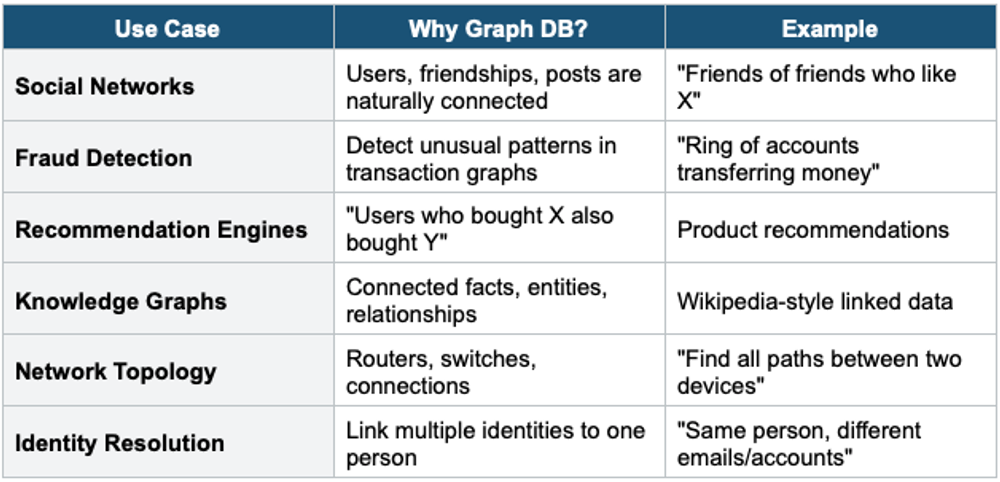
Neptune Exam Signal If the question mentions “graph database,” “highly connected data,” “relationships between entities,” “social network,” “fraud detection with connected patterns,” “knowledge graph,” or “recommendation engine based on relationships,” the answer is Neptune.
3. Amazon QLDB (Quantum Ledger Database)
What is QLDB?
Amazon QLDB is a fully managed ledger database that provides a transparent, immutable, and cryptographically verifiable transaction log. Every change to your data is recorded in an append-only journal that cannot be altered or deleted.
Key Characteristics
- Immutable journal: data changes are append-only (no updates or deletes to the log)
- Cryptographic verification: uses SHA-256 hashing to prove data integrity
- Transparent: full history of all changes is available and verifiable
- Serverless: auto-scales, no capacity provisioning
- 2–3x better performance than traditional blockchain frameworks
- Uses PartiQL (SQL-compatible) query language
- Centralized and owned by a single trusted authority (NOT decentralized like blockchain)
Important Warning QLDB is NOT a blockchain. QLDB is centralized — one trusted authority (your organization) owns and controls the ledger. Blockchain is decentralized — no single authority. If the exam asks about decentralized ledger or multi-party trust, the answer is Amazon Managed Blockchain, NOT QLDB.
QLDB vs Blockchain
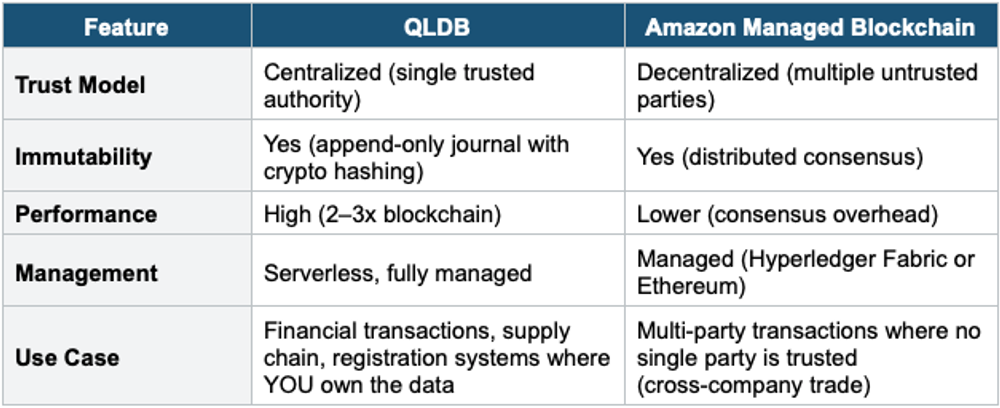
Use Cases
- Financial transaction history (banking, insurance claims)
- Supply chain tracking (provenance of goods)
- Vehicle registration/title transfer history
- HR: employee history tracking
- Any system needing an auditable, tamper-proof record of changes
4. Amazon Timestream
What is Timestream?
Amazon Timestream is a fully managed, serverless time-series database service optimized for collecting, storing, and analyzing time-stamped data at scale.
Key Characteristics
- Purpose-built for time-series data
- Serverless: auto-scales, no capacity planning
- 1000x faster and 1/10th the cost of relational databases for time-series workloads
- Built-in time-series analytics: interpolation, smoothing, approximation, aggregation
- Automatic data lifecycle: recent data in memory store (fast), older data in magnetic store (cheap)
- SQL-compatible query interface
- Supports trillions of data points per day
- Encryption at rest and in transit
Data Tiering
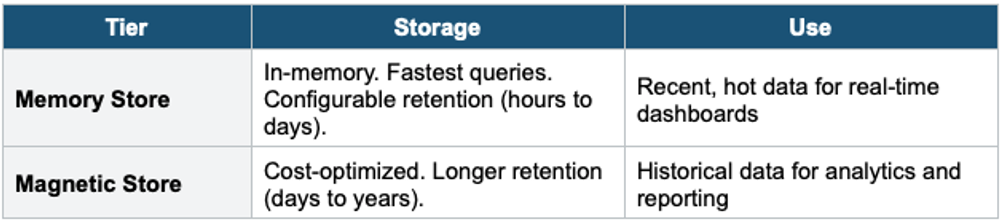
Use Cases
- IoT sensor data (temperature, humidity, pressure)
- Application/infrastructure monitoring metrics (CPU, memory, latency)
- DevOps operational metrics
- Industrial telemetry and equipment monitoring
- Real-time analytics dashboards (integrates with Grafana, QuickSight)
- Clickstream analytics
Timestream Exam Signal If the question mentions “time-series,” “IoT sensor data,” “metrics over time,” “device telemetry,” or “time-stamped data at scale,” the answer is Timestream. It is the only purpose-built time-series database on AWS.
5. Amazon MemoryDB for Redis
What is MemoryDB?
Amazon MemoryDB for Redis is a durable, in-memory database that delivers ultra-fast performance with microsecond reads and single-digit millisecond writes. Unlike ElastiCache Redis (which is primarily a cache), MemoryDB is designed to be your PRIMARY database.
Key Characteristics
- Redis-compatible API — use existing Redis clients and tools
- In-memory performance: microsecond reads, single-digit ms writes
- Durable: uses a distributed, Multi-AZ transaction log for data persistence
- Data survives restarts, failures, and patching (unlike the ElastiCache default)
- Up to 500 nodes per cluster. Scales to >100 TiB.
- Multi-AZ with automatic failover
- Supports all Redis data structures: strings, lists, sets, sorted sets, hashes, streams, etc.
MemoryDB vs ElastiCache for Redis
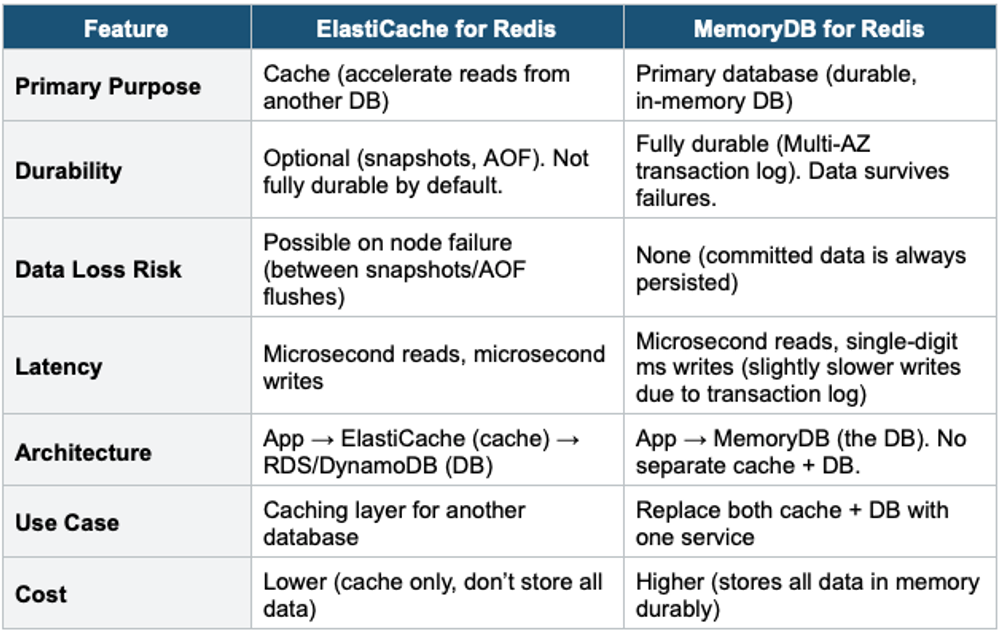
Use Cases
- Applications needing Redis speed + database durability in one service
- Gaming leaderboards, session stores, user profiles (as primary DB)
- Real-time bidding, financial trading platforms
- Replace cache + database architecture with a single durable in-memory DB
MemoryDB Exam Signal If the question asks for a “durable in-memory database” or “Redis as a primary database (not just a cache),” the answer is MemoryDB. If the question asks for “caching layer for RDS/DynamoDB,” the answer is ElastiCache. Key distinction: ElastiCache = cache. MemoryDB = durable database.
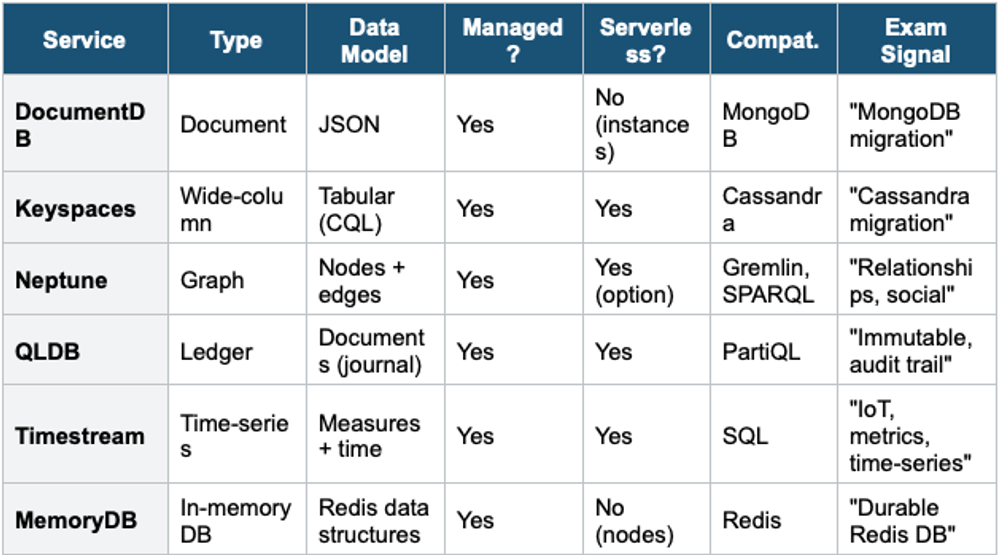
6. Complete Purpose-Built Database Decision Table
7. Full AWS Database Landscape
Here is a complete overview of all AWS database services and their primary use cases:
8. When to use
These are purpose-built databases. Use them when a specific workload doesn't fit well in a general-purpose database like RDS or DynamoDB.
- Amazon Keyspaces (for Apache Cassandra): Migrating existing Cassandra workloads to AWS without rewriting code.High-throughput, low-latency workloads at massive scale (IoT, messaging, user activity). Teams are already familiar with CQL.
- Amazon Neptune: Social networks — friends, followers, recommendations. Fraud detection — find suspicious patterns across connected entities. Knowledge graphs — map complex relationships between concepts. Network topology — model IT infrastructure, dependencies. Any workload where relationships between data are the primary concern.
- Amazon QLDB (Quantum Ledger Database): Financial transactions — need a complete, tamper-proof audit trail. Regulatory compliance — prove that data was never modified. Supply chain — track every change to an item's record. Any system that needs a cryptographically verifiable history of all changes.
- Amazon Timestream: IoT sensor data — temperature, pressure, device telemetry. Application metrics — monitoring, observability dashboards. DevOps monitoring — track infrastructure performance over time. Financial tick data — stock prices, trade events. Any workload where data is indexed and queried by time.
- Amazon MemoryDB for Redis: Need Redis as a primary/durable database, not just a cache. Session stores — durable, ultra-fast user sessions. Leaderboards, real-time apps — need persistence + speed. Microservices — fast, durable data layer with Redis API.
Exam Tip Purpose-Built DB questions: Match the workload to the database. "MongoDB" = DocumentDB. "Cassandra" = Keyspaces. "Graph / social / fraud" = Neptune. "Immutable ledger/audit" = QLDB. "Decentralized blockchain" = Managed Blockchain (NOT QLDB). "Time-series / IoT" = Timestream. "Durable Redis primary DB" = MemoryDB. "Redis cache" = ElastiCache. The exam tests your ability to pick the right database for the right workload.