1. Overview
The AWS Well-Architected Framework helps cloud architects build secure, high-performing, resilient, and efficient infrastructure for their applications. It provides a consistent approach to evaluating architectures and implementing designs that scale.
Key Concept The Well-Architected Framework consists of 6 pillars. Each pillar represents a fundamental area of cloud architecture best practices. Memorize all 6 pillars — they are heavily tested.
2. The Six Pillars
Pillar 1: Operational Excellence
Focus: Run and monitor systems to deliver business value and continually improve processes and procedures.
- Perform operations as code (Infrastructure as Code)
- Make frequent, small, reversible changes
- Anticipate failure and learn from operational events
- Key AWS Services: CloudFormation, AWS Config, CloudWatch, CloudTrail
Pillar 2: Security
Focus: Protect information, systems, and assets while delivering business value through risk assessments and mitigation strategies.
- Implement a strong identity foundation (principle of least privilege)
- Enable traceability — log and audit all actions
- Apply security at all layers (edge, VPC, subnet, instance, OS, application)
- Automate security best practices
- Protect data in transit and at rest
- Key AWS Services: IAM, KMS, CloudTrail, Shield, WAF, GuardDuty
Pillar 3: Reliability
Focus: Ensure a workload performs its intended function correctly and consistently when it’s expected to.
- Automatically recover from failure
- Test recovery procedures
- Scale horizontally to increase aggregate workload availability
- Stop guessing capacity — use auto scaling
- Key AWS Services: Auto Scaling, CloudWatch, Route 53, S3, RDS Multi-AZ
Pillar 4: Performance Efficiency
Focus: Use computing resources efficiently to meet system requirements and maintain that efficiency as demand changes and technologies evolve.
- Use serverless architectures where possible
- Go global in minutes using multiple Regions
- Experiment more often with new technologies
- Key AWS Services: Lambda, EC2 Auto Scaling, ElastiCache, CloudFront
Pillar 5: Cost Optimization
Focus: Avoid unnecessary costs. Understand and control where money is being spent and select the most appropriate resource types.
- Adopt a consumption model (pay only for what you use)
- Measure overall efficiency
- Stop spending money on undifferentiated heavy lifting
- Analyze and attribute expenditure
- Key AWS Services: Cost Explorer, Budgets, Trusted Advisor, Reserved Instances, Spot Instances
Pillar 6: Sustainability
Focus: Minimize the environmental impacts of running cloud workloads.
- Understand your impact
- Establish sustainability goals
- Maximize utilization and minimize waste
- Use managed services to reduce your carbon footprint
Key AWS Services: EC2 Auto Scaling, Graviton instances, S3 Intelligent-Tiering
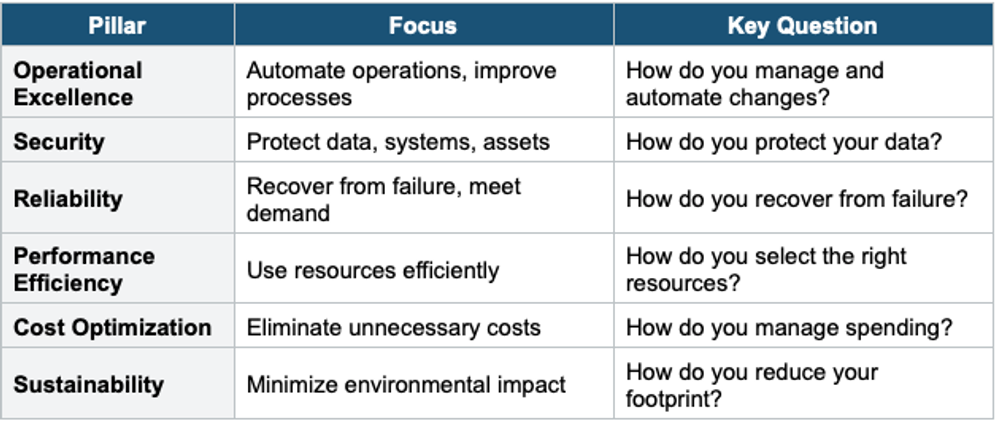
3. Six Pillars Summary Table
4. AWS Well-Architected Tool
- Free tool in the AWS Console
- Provides a structured way to review your workloads against the 6 pillars
- Generates a report with improvement recommendations
- Access it via: AWS Console → Well-Architected Tool
5. When to use
Use the Well-Architected Framework when you need to evaluate, improve, or design cloud architectures using AWS best practices.
Common scenarios:
- Design new workloads — Follow proven guidelines before building on AWS.
- Review existing architectures — Identify risks and areas for improvement.
- Prepare for audits/compliance — Demonstrate your architecture follows industry best practices.
- Exam questions about best practices — The framework is heavily tested across all AWS exams.
- Cost and performance optimization — Systematically find waste and bottlenecks.
Exam Tip Memorize the 6 pillars using the mnemonic: "OSRPCS" — Operational excellence, Security, Reliability, Performance efficiency, Cost optimization, Sustainability. The exam often asks you to identify which pillar a specific best practice belongs to.