1. The Six Advantages of Cloud Computing (AWS Official)
AWS officially lists six advantages of cloud computing. These are heavily tested on the exam:
1. Trade Capital Expense (CapEx) for Variable Expense (OpEx)
- Instead of investing heavily in data centers before you know how you’ll use them, you pay only when you consume resources.
- No upfront cost. Pay only for what you use.
- CapEx: Buying servers, building data centers (traditional)
- OpEx: Paying monthly for cloud usage (cloud model)
2. Benefit from Massive Economies of Scale
- Cloud providers like AWS aggregate usage from hundreds of thousands of customers.
- This allows them to achieve higher economies of scale, which translates into lower pay-as-you-go prices.
- You can never achieve the same cost efficiency on your own.
3. Stop Guessing Capacity
- In traditional IT, if you underestimate, your apps go down. If you overestimate, you waste money on idle servers.
- Cloud computing lets you access as much or as little as you need, and scale up or down in minutes.
4. Increase Speed and Agility
- New IT resources are a click away — reducing development time from weeks to minutes.
- This dramatically increases agility because the cost and time to experiment is significantly lower.
5. Stop Spending Money Running and Maintaining Data Centers
- Focus on your business, not on managing infrastructure.
- Let the cloud provider handle the heavy lifting of racking, stacking, and powering servers.
6. Go Global in Minutes
- Deploy your application in multiple AWS Regions around the world with just a few clicks.
- This means lower latency and a better experience for your customers at minimal cost.
Memory Aid for 6 Advantages
Remember: Trade CapEx, Economies of Scale, Stop Guessing, Speed & Agility, Stop Maintaining DCs, Go Global. Mnemonic: "Trade Economies, Stop Guessing, Speed Stops, Go!" or simply TESGSG.
2. Additional Benefits (Beyond the Six)
- High Availability: AWS services are designed to be available across multiple Availability Zones (AZs), reducing downtime.
- Fault Tolerance: Built-in redundancy ensures systems continue operating even when components fail.
- Disaster Recovery: Cloud makes it easier and cheaper to implement backup and recovery strategies.
- Security: AWS invests heavily in security. The Shared Responsibility Model defines who secures what.
- Elasticity: Automatically scale resources up or down based on real-time demand.
3. CapEx vs. OpEx Deep Dive
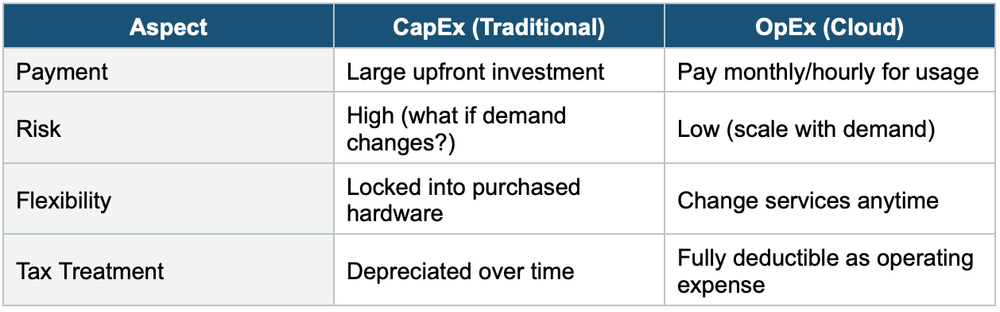
Exam Tip
AWS loves to test the 6 advantages. The most commonly tested are: Trade CapEx for OpEx, Stop Guessing Capacity, and Economies of Scale. If a question mentions reducing upfront costs, the answer relates to trading CapEx for variable expense (OpEx).